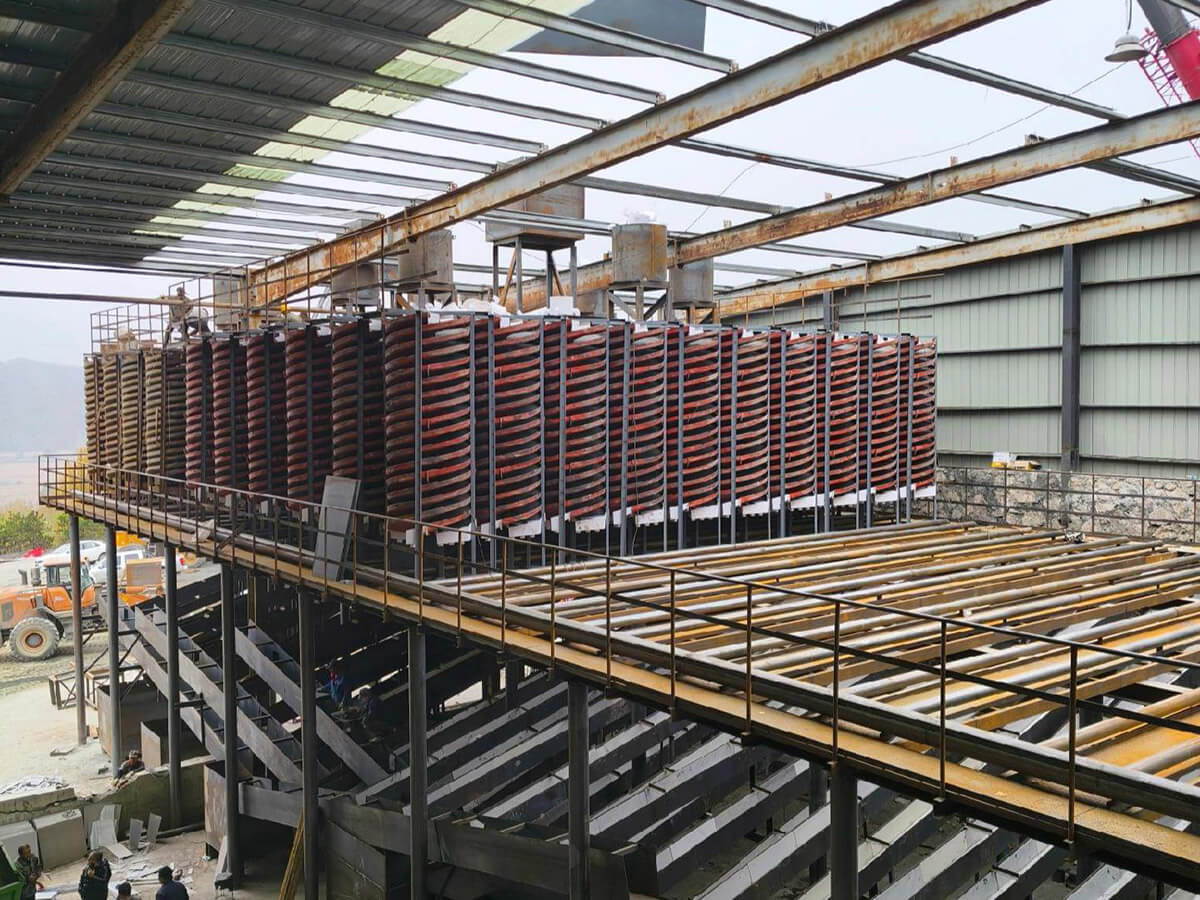
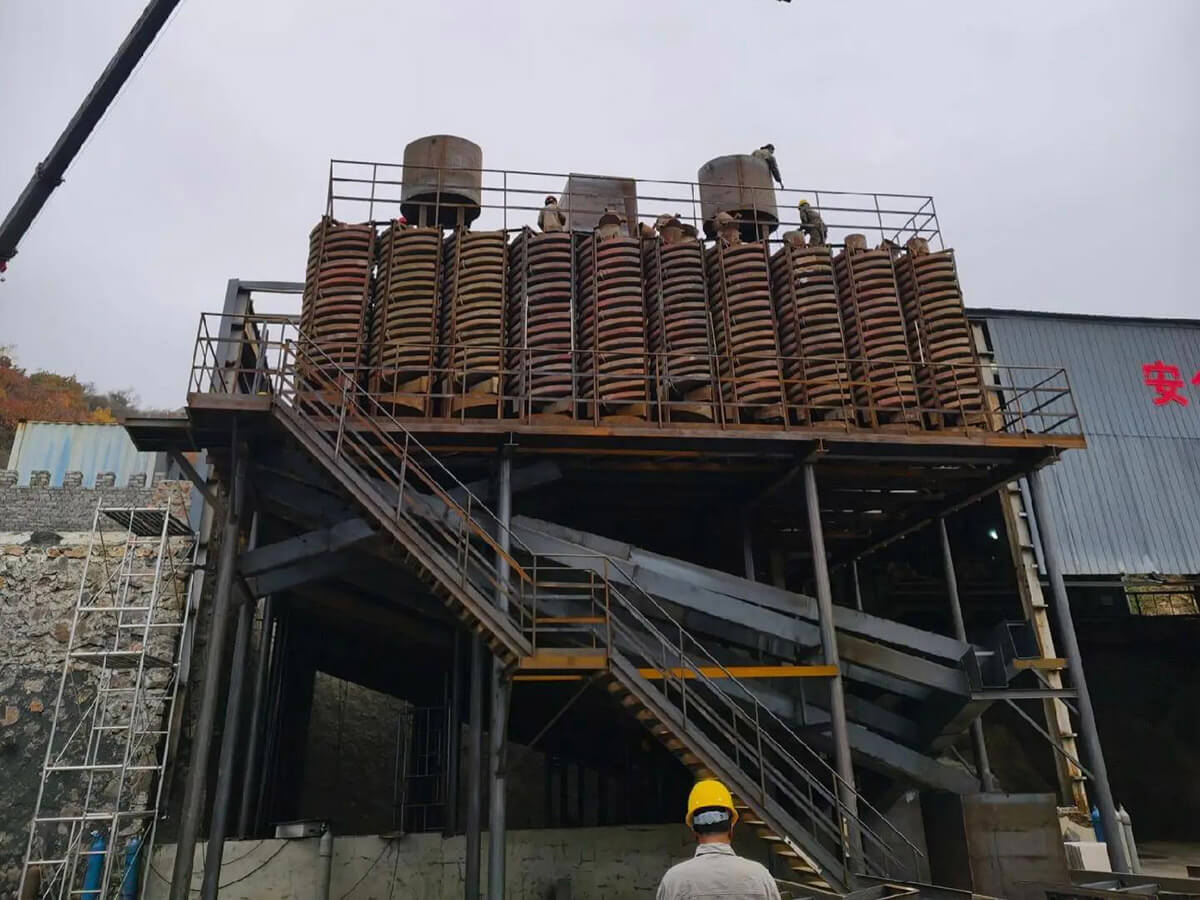
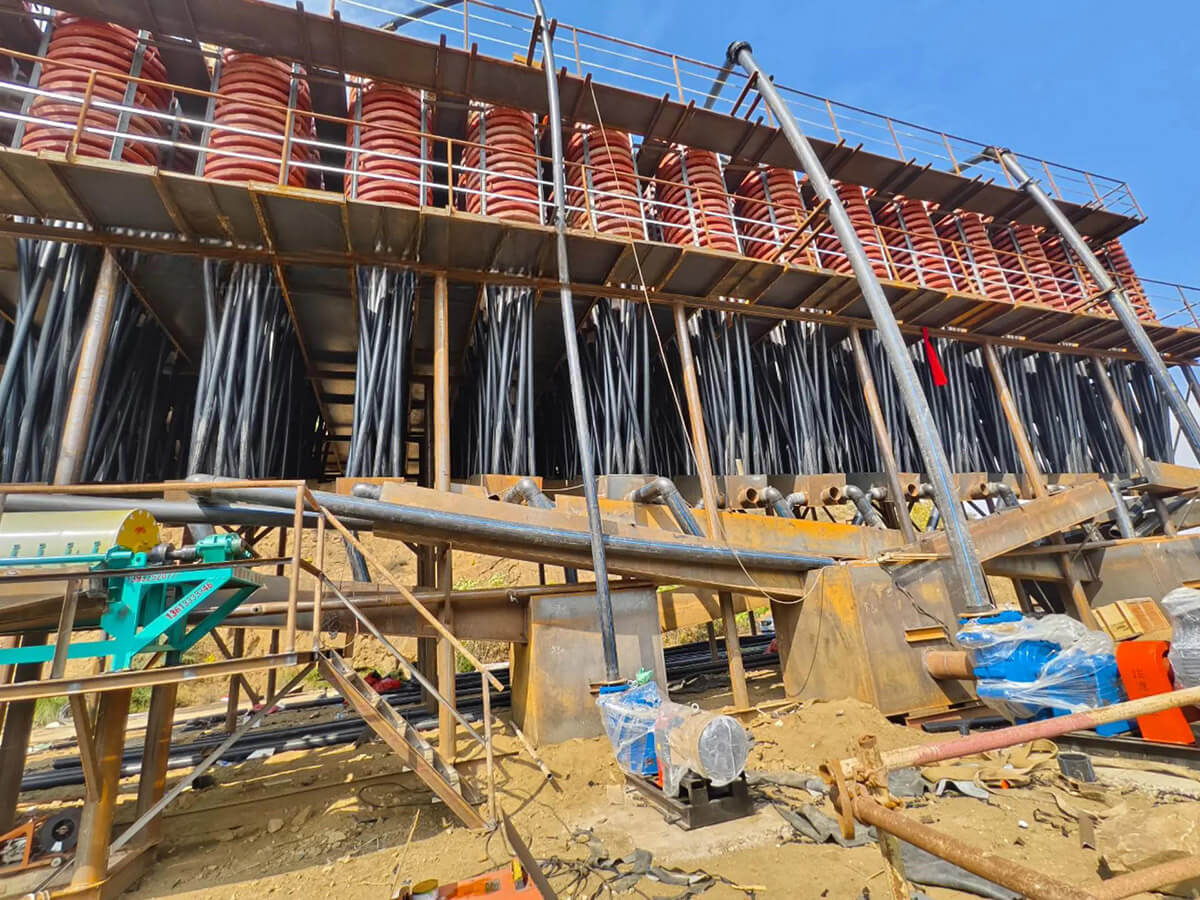
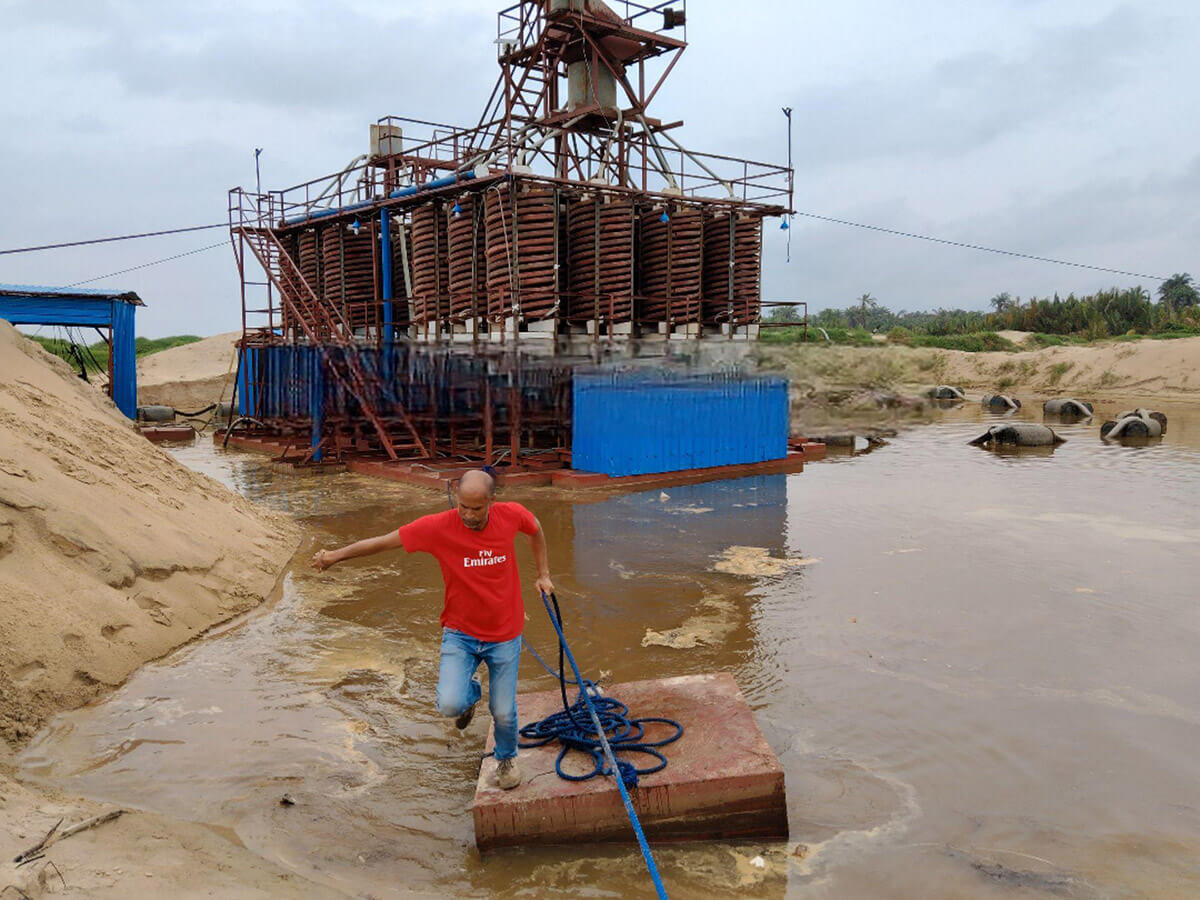

Spiral sluices are a type of high-efficiency, energy-saving gravity separation equipment widely used in the separation of metallic and non-metallic minerals. They utilize the different trajectories of mineral particles in a spiral inclined water flow due to differences in specific gravity, particle size, and shape to achieve effective mineral separation. They offer advantages such as simple structure, no power consumption, and convenient operation and maintenance, making them particularly suitable for placer mining scenarios such as coastal areas, riverbanks, and sandy beaches.
Working Principle
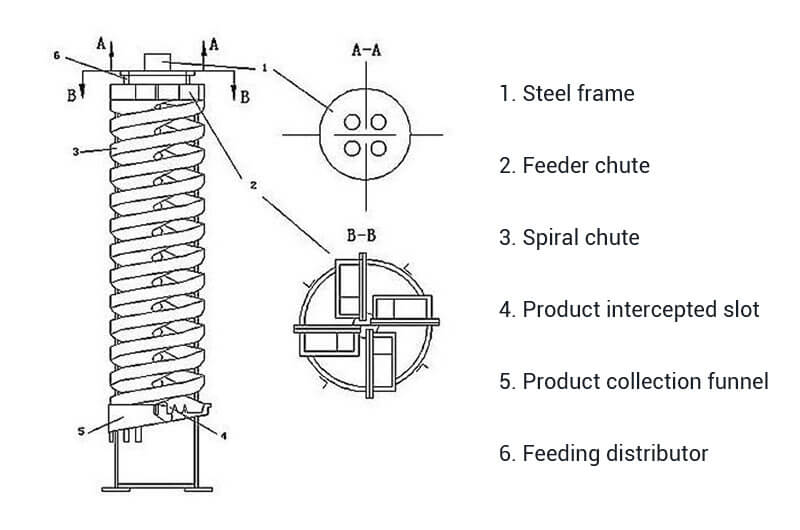
The core principle of the spiral sluice is based on the combined force field of gravity and centrifugal force. The slurry enters the spiral sluice uniformly from the top feed inlet. During its downward swirling flow, it is subjected to the combined effects of the following forces:
- Gravity: Causes particles to move vertically downwards.
- Centrifugal force: Generated by the spiral motion, it throws particles outwards.
- Hydrodynamics and lateral circulation: The upper layer of water flows faster and outwards; the lower layer flows slower and inwards, forming a "secondary circulation" that continuously washes the particles.
- Friction and bed reaction force: Influence the sliding and settling of particles on the sluice surface.
Dense heavy minerals (such as iron ore, tin ore, and gold ore) settle quickly, entering the bottom layer of the liquid flow and moving inwards along the converging spiral line; lighter minerals float on the upper layer and move outwards along the expanding spiral line. Finally, at the tail end of the sluice, a collector collects the concentrate, middlings, and tailings radially, achieving efficient separation.
Product Structure
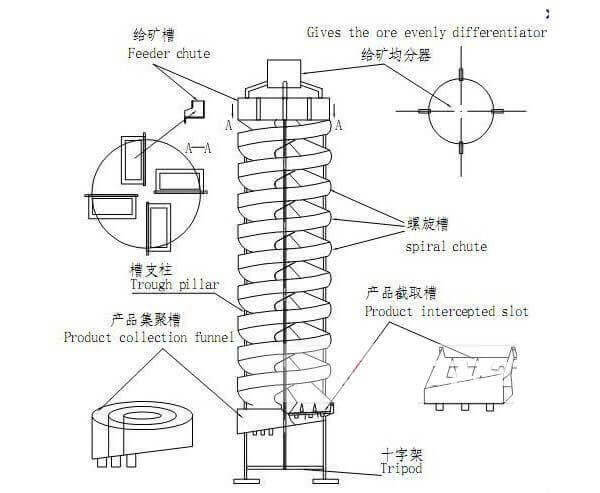
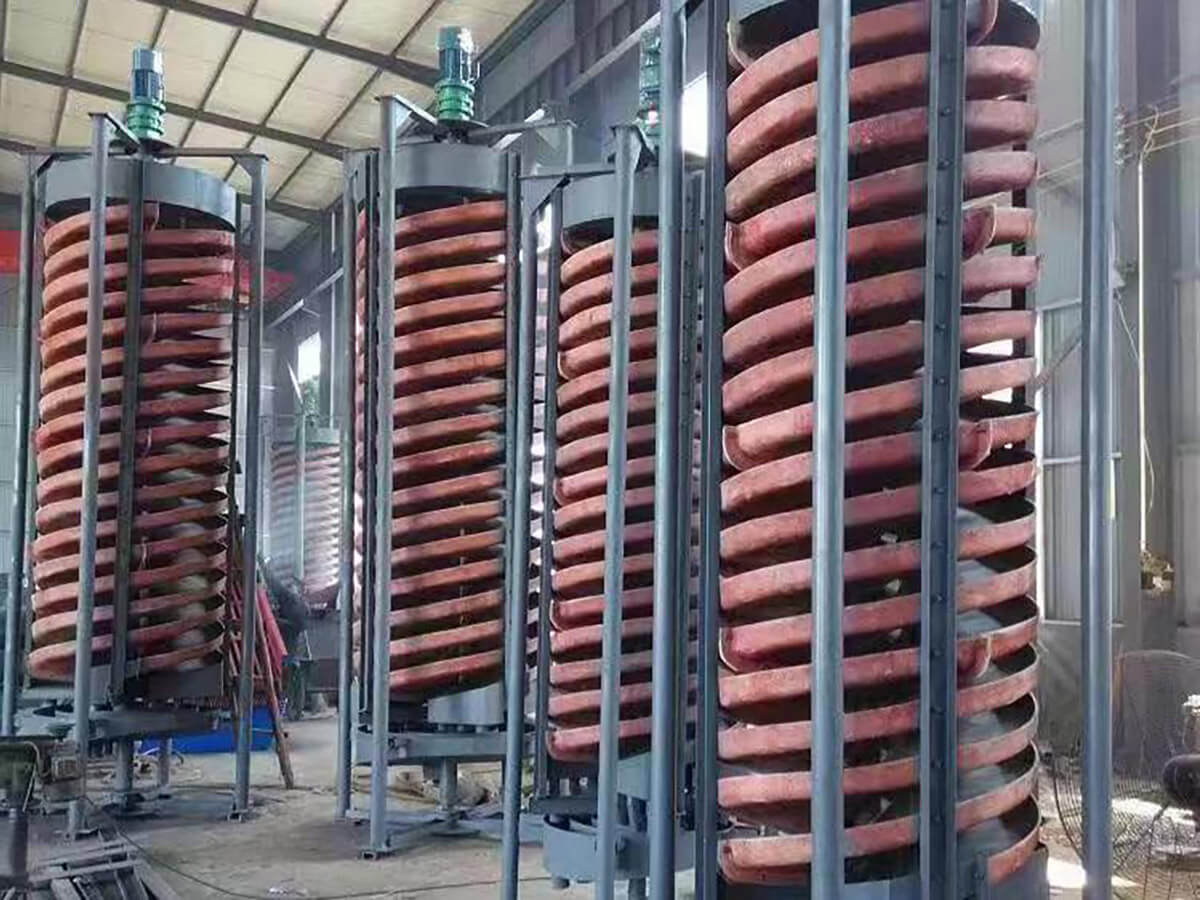
A spiral chute mainly consists of the following six parts:
- Divider Hopper (Divider): Distributes the slurry evenly to multiple spiral heads, ensuring stable feeding.
- Feed Trough: Guides the slurry smoothly into the spiral chute surface.
- Spiral Chute (Main Component): Constructed from fiberglass (glass fiber reinforced plastic) spiral blades connected by bolts, with an inner surface coated with polyurethane or an epoxy resin wear-resistant layer mixed with corundum.
- Product Separator (Screwing Device): Located at the end of the spiral chute, it features adjustable valve blocks to separate 2–4 products according to grade.
- Collection Hopper (Accumulating Hopper): Collects and discharges the separated products.
- Steel Support (Cross or Tripod): Supports the entire equipment, maintaining vertical installation.
The equipment is typically configured with single, double, triple, or quadruple heads, and industrially, it is often arranged in groups to increase processing capacity.
Product Advantages
- Energy-Saving and Environmentally Friendly: With no moving parts, it relies on natural gravity vortex flow, resulting in zero energy consumption and low noise.
- Stable Mineral Processing and High Enrichment Ratio: Highly adaptable to fluctuations in feed rate, concentration, particle size, and grade, with stable separation indicators and a recovery rate exceeding 93%.
- Large Processing Capacity and High Efficiency: A single unit can process 0.15–40 tons/hour, suitable for large-scale production.
- Simple Structure and Easy Installation: Small footprint, convenient operation and maintenance, low investment, and quick returns.
- Superior Material and Corrosion Resistance: Lightweight and sturdy fiberglass material, moisture-proof, rust-proof, corrosion-resistant, and long service life.
- Modular Design and Flexible Configuration: Can be combined in multiple units or connected in series to meet production capacity requirements.