
Dry Stacking Process For Tailings
Date: 2026-02-27 Categories: Rare Metals Views: 252
The dry stacking process for lithium mine tailings is a tailings disposal method that has been promoted in recent years to improve mine safety and environmental protection. Its core lies in using efficient dewatering technology to reduce the moisture content of tailings to below 20%, forming "dry cakes" which are then transported to a storage yard for layered stacking. Compared to traditional wet tailings dams, this process significantly reduces the risk of dam failure and increases water reuse rates (up to 95%), making it particularly suitable for arid, water-scarce, or high-altitude, freezing-prone areas.
Mainstream Lithium Mine Tailings Dry Stacking Process
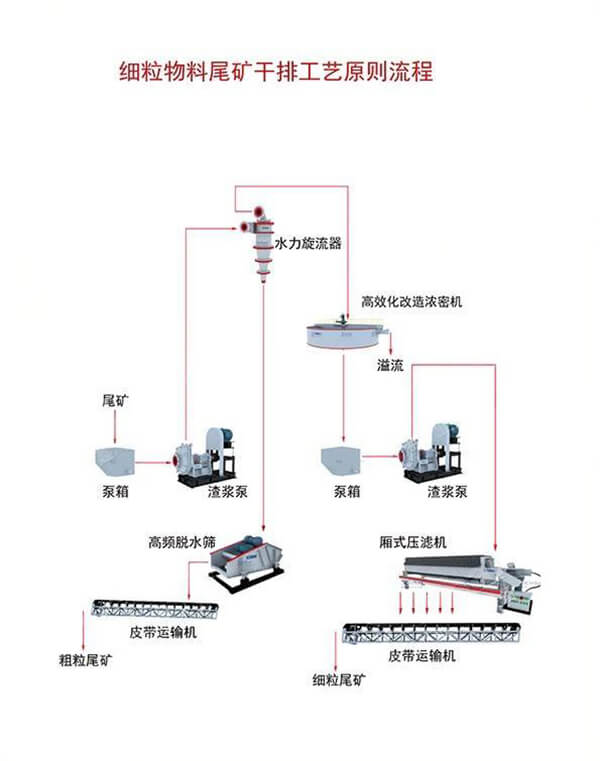
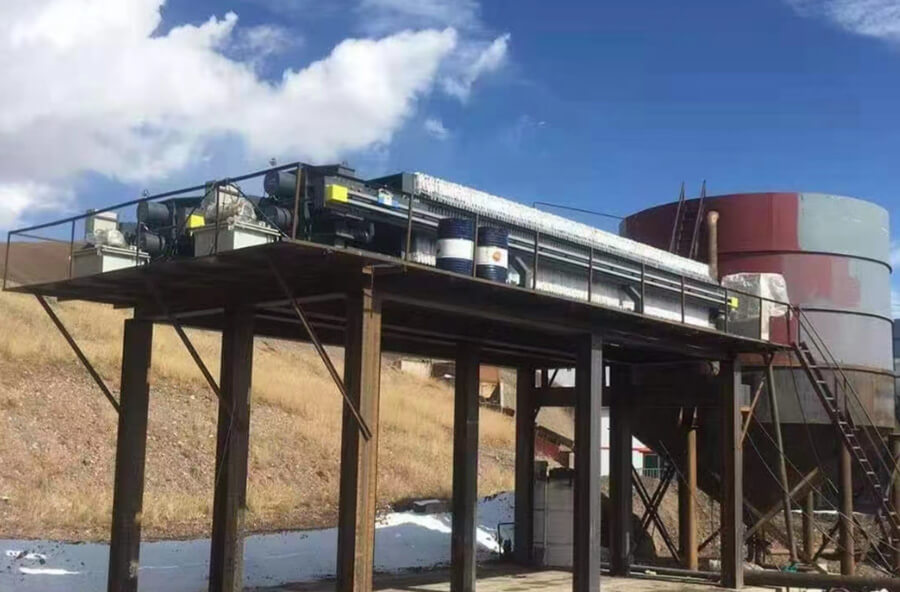
1. Combined dewatering process of hydrocyclone, thickening machine, and filter press
- Applicable conditions: Medium to coarse-grained lithium tailings (such as spodumene flotation tailings)
- Process structure:
- The tailings slurry first enters a hydrocyclone for preliminary thickening, achieving an underflow concentration of over 60%.
- The overflow then enters a deep cone thickener for further thickening to approximately 70%.
- The thickener underflow is fed into a vertical filter press or belt filter press, where the moisture content is controlled to below 18%.
- The dried cake is transported by belt conveyor or truck to a dry stockpile for stratified compaction and stacking.
- Advantages: High dehydration efficiency and high water recycling rate, suitable for medium and large-sized beneficiation plants.
- Case support: A 2500TPD lithium ore beneficiation plant in Sichuan adopted this process to achieve zero on-site discharge and recycling of recycled water.
2. Hydrocyclone—High-Frequency Screen—Thickener—Solid Pump System
- Applicable conditions: Lithium tailings with a high content of fine particles (-325 mesh <80%).
- Technical Highlights:
- High-frequency dewatering screens can quickly separate coarse particles, with the oversize material directly output as dry material.
- Fine particles are processed by a thickener, resulting in a low overall system investment and operating costs that are only half that of traditional filter presses.
- Complete tailings dry discharge is possible, making it suitable for cost-sensitive small and medium-sized mines.
3. Paste Storage Process
- Applicable Conditions: Scenarios with a high proportion of fine particles and requiring long-distance pipeline transportation.
- Key Requirements: Particles smaller than 20μm in the tailings must account for more than 15% to form a stable paste.
- Transportation Method: The paste-like tailings are transported to the center of the storage yard via pipeline for discharge, where they are gravity-fed to form a gently sloping accumulation (slope 5%–7%).
- Advantages: No need for dam construction, flexible storage, and convenient ecological restoration, but requires high equipment and control precision.
4. New type of bagged dry stacking
- Applicable conditions: Small-scale mines, areas with long rainy seasons or heavy rainfall.
- Technological characteristics:
- After adding flocculants, the tailings slurry is poured into special membrane bags, relying on natural dehydration and gravity compaction.
- The stockpile is stable and not easily eroded by rainwater, and can be reclaimed and greened after its service life.
- Initial investment is low, making it suitable for temporary or transitional storage needs.