
Trends in The Mineral Processing Industry
Date: 2026-03-03 Categories: Industry News Views: 197
Global Trends in the Mineral Processing Industry
Geopolitical Landscape Reshapes Supply Chains, Intensifying Resource Competition
Increasingly fierce global geopolitical conflicts are prompting countries to accelerate the construction of domestic and regional supply chains to reduce dependence on single countries or regions. For example, the United States is adopting a "friendly sourcing" strategy to reduce its reliance on critical minerals from China, while collaborating with allies to establish critical mineral alliances (such as the "Quadrilateral Critical Minerals 2025 Initiative" involving the United States, Japan, India, and Australia). This trend poses challenges to the localization and regionalization of supply chains in the mineral processing industry, requiring companies to adopt diversified resource allocation and flexible supply chain management to mitigate risks.
ESG is Becoming an Industry Entry Barrier, Driving Green Transition
Environmental, Social, and Governance (ESG) has shifted from a "bonus" to a prerequisite for mining companies to enter the market. International mining companies are enhancing their competitiveness through quantifiable ESG practices, such as adopting low-carbon beneficiation technologies, reducing water consumption, and minimizing tailings emissions. Domestically, guided by "dual carbon" targets, the construction of green mines is driving sustainable development. Mineral processing equipment must meet low-energy consumption and low-emission standards, prompting enterprises to increase investment in green technology research and development.
Accelerating digital transformation, with smart mines as the core direction
New technologies such as artificial intelligence (AI), big data, and the Internet of Things (IoT) are reshaping the mineral processing industry. AI-powered mineral exploration technology improves exploration efficiency by analyzing geophysical and geochemical data; smart mines reduce operating costs by monitoring equipment status in real time and optimizing production processes. For example, the improvement of integrated space-ground remote sensing mineral exploration technology systems and the green automation development of low-grade, difficult-to-process ore processing technologies demonstrate the significant effectiveness of digitalization in improving mineral processing efficiency.
Supply and demand are diverging, with a surge in demand for new energy minerals.
Weak demand for traditional bulk minerals (such as iron ore and coal) has exacerbated the oversupply, while demand for new energy minerals (such as lithium, cobalt, and nickel) is growing rapidly. Although the short-term oversupply is putting downward pressure on prices, a long-term supply gap remains. Mineral processing equipment must adapt to the characteristics of different minerals; for example, developing efficient flotation technology for low-grade lithium ore, or improving the efficiency of rare earth ore beneficiation through multi-force field and automation equipment.
To ensure resource security, countries are strengthening their control over key minerals through mergers and acquisitions.
For example, Chinese companies have completed approximately $15.4 billion in mergers and acquisitions globally, mainly concentrated in the new energy metals sector, such as cobalt, lithium, and nickel. Meanwhile, the United States and its allies are accelerating mining development domestically and in friendly waters through government guidance and market investment. This divergence in capital flows will affect regional demand for mineral processing equipment, requiring companies to adjust their market strategies to adapt to different regional policy environments.
Technological innovation drives equipment upgrades, emphasizing large-scale and intelligent solutions.
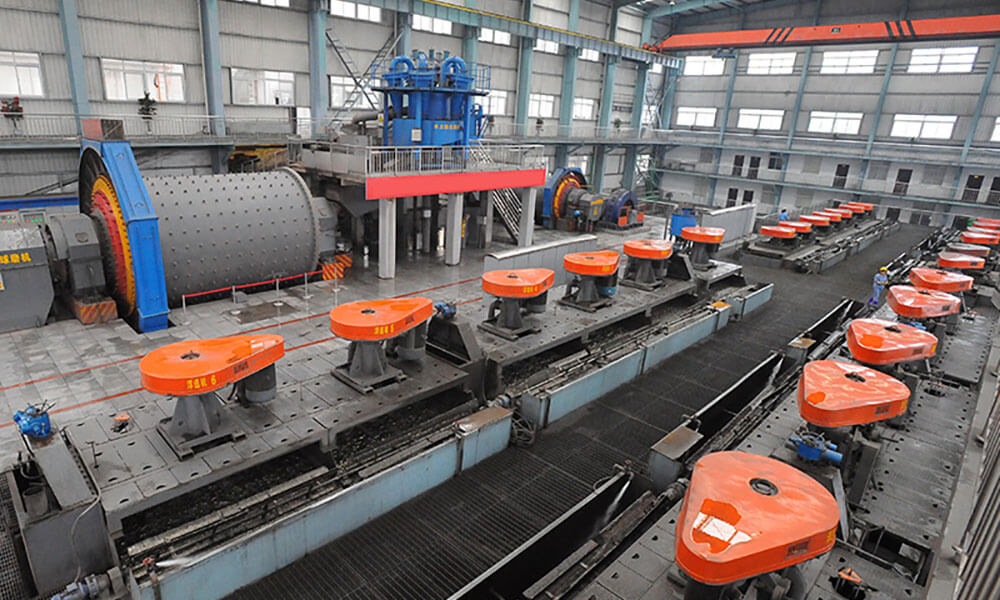
To meet the demands of low-grade mineral resource development, the focus of mineral processing equipment R&D is shifting towards large-scale, multi-force field, automated, and multidisciplinary solutions. For example, large flotation machines reduce unit costs by increasing processing capacity, while intelligent control systems optimize beneficiation efficiency by adjusting operating parameters in real time. Furthermore, the green and automated development of low-grade, difficult-to-process minerals technologies is also driving innovation in energy-saving and environmentally friendly beneficiation equipment.
The global mining landscape is shifting, with regional market differentiation intensifying.
The core of global mining competition is shifting from "scale expansion + efficiency priority" to "resilient reconstruction + security and controllability." For example, Africa has become the region with the largest increase in global iron ore capital expenditure, with the Simandou iron ore project expected to reach a capacity of 30-40 million tons by 2026, and Chinese companies playing a leading role in its development. This regional market differentiation requires mineral processing equipment companies to possess localized service capabilities to adapt to the resource endowments and policy requirements of different regions.