
The Principle and Advantages of Sawtooth Wave Jigs
Date: 2026-03-04 Categories: Equipment Knowledge Views: 189
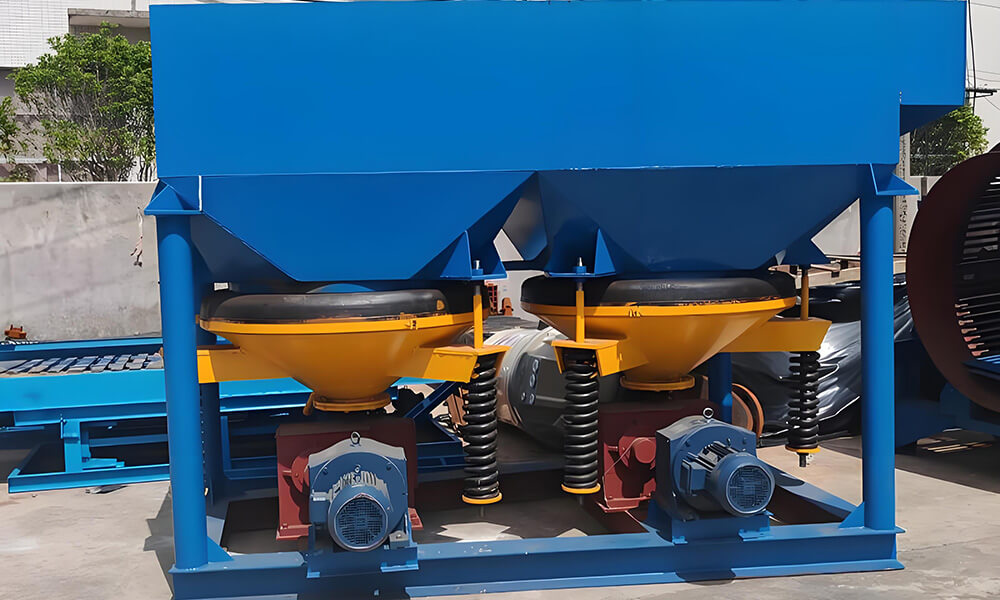
The sawtooth wave jig is a high-efficiency and energy-saving mineral processing equipment based on the principle of gravity separation. Its core is to achieve precise stratification of mineral particles according to specific gravity through a special water flow pulsation curve. It is widely used in the separation of metallic and non-metallic minerals.
Working Principle
The sorting process of a sawtooth wave jig relies on an asymmetric, sawtooth-shaped pulsating water flow. Unlike traditional sinusoidal wave jigs, its water flow exhibits a "rapid ascent, slow descent" characteristic:
- Ascent Phase: The water flows rapidly and uniformly upwards, loosening the mineral particles and briefly suspending them.
- Descent Phase: The water flow descends slowly and for a longer duration, creating ample settling conditions for high-density mineral particles (such as tin, tungsten, and gold);
- During this process, heavy minerals gradually pass through the loose bed and sink to the bottom, while lighter gangue is lifted to the surface. Finally, the concentrate and tailings are collected separately through the discharge system.
This waveform design overcomes the shortcomings of the symmetrical water flow velocity and duration in sinusoidal wave jigs, significantly enhancing the looseness of the bed and the density-based stratification of minerals.
Main Advantages
-
High Sorting Efficiency
- Compared to traditional jigs, sawtooth wave jigs offer a significant improvement in recovery rate:
- Tin (Sn) increased by 3.01%.
- Tungsten (W) increased by 5.5%.
- Lead (Pb) increased by 1.63%.
- Zinc (Zn) increased by 2.04%.
- It is particularly beneficial for the recovery of fine-grained valuable minerals and effectively reduces metal loss.
- Compared to traditional jigs, sawtooth wave jigs offer a significant improvement in recovery rate:
-
Energy Saving and Environmental Protection
- Water consumption reduced by 30%-40%
- The unit processing capacity occupies one-third less space, making it suitable for space-constrained ore processing plants.
- It adopts an electromagnetic speed-regulating motor, which can steplessly adjust the stroke rate and has lower operating energy consumption.
-
Highly Adaptable
- It can handle a wide range of particle sizes, with a maximum feed particle size of 30mm, and is suitable for multiple stages of roughing and cleaning.
- Both the stroke and the number of strokes are adjustable, allowing for flexible responses to changes in the properties of different ores.
- It is widely used for the beneficiation of various minerals such as tungsten, tin, gold, iron, manganese, and barite, and is also suitable for tailings reprocessing and metal recovery from smelting slag.
-
Easy to Operate and Maintain
- Compact structure and easy installation.
- Employing a cam or mechanical transmission mechanism ensures stable and reliable operation.
- It supports continuous operation and is suitable for large-scale industrial production.