
The Principle and Function of Spiral Chute
Date: 2026-03-04 Categories: Equipment Knowledge Views: 183
The Principle of Spiral Chute
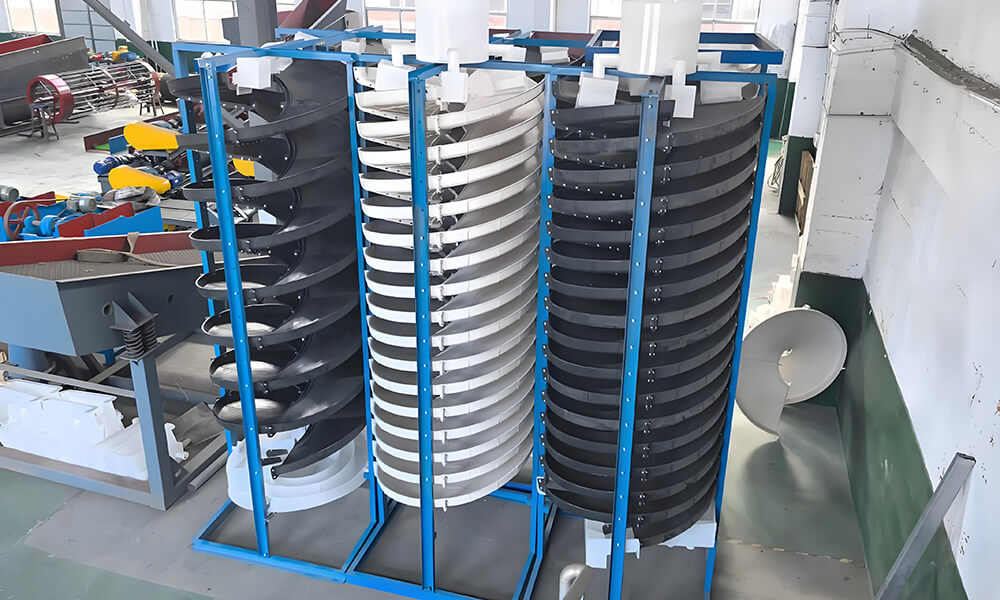
Separation based on density difference: Spiral sluices utilize the difference in settling velocities caused by differences in particle density to achieve separation. After the slurry enters from the top of the spiral sluice, under the combined action of gravity, water flow resistance, centrifugal force, and friction, heavy minerals (such as tungsten and tin) rapidly settle to the lower layer of the liquid flow, while light minerals (such as quartz and feldspar) settle slowly and float to the upper layer.
Forming of cross-sectional circulation: As the liquid flows along the surface of the spiral sluice, its direction constantly changes, generating centrifugal force. This creates a transverse liquid surface slope from the outer edge to the inner edge of the spiral sluice's cross-section. Upper liquid particles are guided towards the outer edge of the sluice by the resultant transverse force, while lower liquid particles flow towards the inner edge due to the transverse liquid surface slope. The transverse velocity in the middle layer is zero. This continuous water flow creates cross-sectional circulation within the spiral sluice. The water layer at the inner edge is thinner and has a lower velocity, while the water layer at the outer edge is thicker and has a higher velocity. The transverse inclination angle of the sluice surface enhances the cross-sectional circulation.
The Process of Separating Ore Particles
Stratification of Particles: Heavy minerals settle quickly and sink to the lower layer of the liquid flow; light minerals settle slowly and float to the upper layer. Vertical disturbance of the liquid flow exacerbates the stratification of ore particles according to density.
Lateral Diffusion of Light and Heavy Minerals: Heavy minerals settling in the lower layer experience less centrifugal force. The inward thrust of the lateral water flow and the sliding force generated by the gravity of the mineral particles overcome the friction and centrifugal force at the bottom of the trough, causing the heavy minerals to gradually move towards the inner edge along the spiral. Light minerals floating in the upper layer experience greater centrifugal force and, under the action of the outward thrust of the lateral water flow, gradually move towards the outer edge along the spiral, while sludge is thrown to the outermost edge.
Achieving Kinematic Equilibrium: Mineral particles of different densities move along their respective radii of rotation. Light and heavy minerals are evenly distributed from the outer edge to the inner edge. The separator installed at the discharge end of the sluice divides the mineral belt laterally into three parts: concentrate, middlings, and tailings, which are then discharged through their respective discharge pipes, completing the separation process.
Function of Spiral Chute
High-efficiency mineral separation: This equipment has a high separation capacity for minerals with significant density differences (such as tantalum, niobium, tin, and tungsten), enabling the extraction of these minerals from the raw ore and improving mineral recovery and enrichment ratios. For example, in processing tungsten and tin ores, this equipment can effectively separate valuable minerals from gangue, thereby obtaining high-grade concentrates.
Fine-grained ore processing: Suitable for separating various ores with particle sizes of 0.3–0.02 mm, including iron ore, ilmenite, chromite, pyrite, zircon, rutile, monazite, and phosphate rock. It is an effective method for processing fine-grained ores.
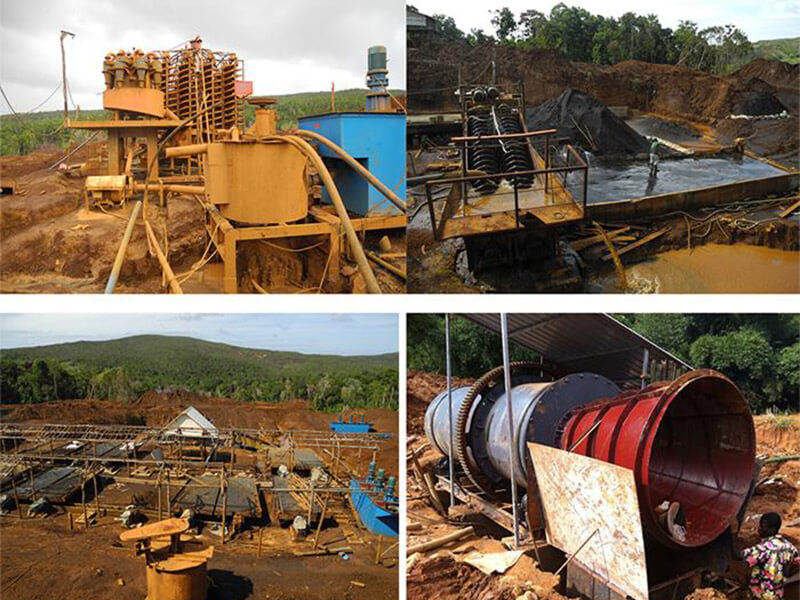
Adaptability to various environments: It is particularly suitable for mining placer gold deposits in coastal areas, riverbanks, beaches, and streams, where it can be easily installed and used for ore separation operations.
Energy Saving and Environmental Protection
Compact structure and low energy consumption: Its separation method requires no flushing water, featuring a compact structure, stable operation, and low energy consumption, meeting the industry's requirements for energy conservation and environmental protection.
Reduced pollution emissions: Higher recovery rates mean that more minerals can be effectively extracted, thereby reducing the amount of valuable elements remaining in tailings and mitigating potential pollution risks associated with tailings ponds, such as heavy metal leachate pollution of soil and water bodies.