
Manganese Ore Processing Technology
Date: 2026-02-27 Categories: Iron Metal Views: 236
Manganese ore processing involves treating raw ore using physical, chemical, or combined methods to improve manganese grade, remove impurities, and prepare manganese concentrates or manganese compounds that meet the needs of industries such as metallurgy, chemicals, and batteries. Depending on the ore type (e.g., manganese oxide ore, manganese carbonate ore), particle size distribution, impurity content, and final product requirements, the process flow can be flexibly combined. It typically includes core steps such as mining, crushing, grinding, beneficiation, and dewatering. In some cases, sintering, chemical processing, or smelting may also be required.
I. Mining: Selecting mining methods according to local conditions
The mining method for manganese ore mainly depends on the occurrence conditions of the ore body:
- Open-pit mining: Suitable for shallowly buried mines with good surface conditions, using blasting, excavation, and transportation equipment to efficiently extract ore;
- Underground mining: Used in areas with deeply buried ore bodies or complex terrain, requiring higher technical standards and stricter safety management.
II. Crushing and Screening: Achieving Particle Size Control and Preliminary Grading
Crushing is a key preparatory step before mineral processing, with the aim of crushing large pieces of raw ore to a particle size suitable for subsequent processing.
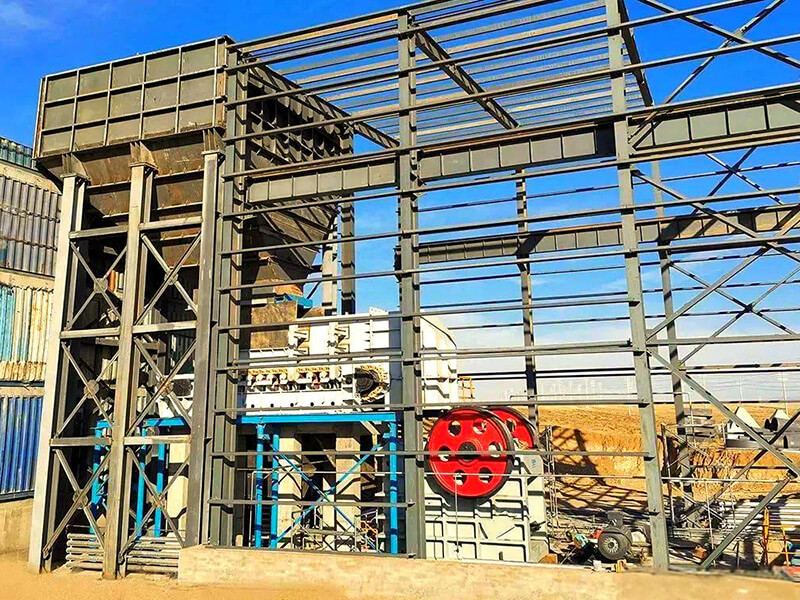
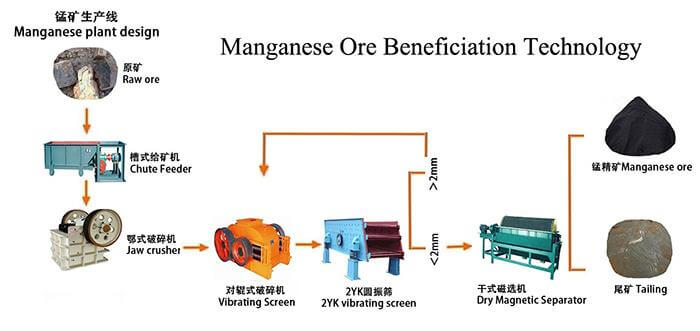
- Coarse crushing: Jaw crushers are used to crush the ore to below 100mm.
- Medium and fine crushing: Cone crushers or impact crushers are used to further crush the ore to 6-10mm.
- Screening: Vibrating screens are used to classify the crushed ore according to particle size. Unqualified particles are returned for further crushing to ensure that the material entering the grinding stage has a uniform particle size.
III. Ore washing and desliming: Removing mud interference
It is especially suitable for weathered manganese oxide ores, which often contain a large amount of mud and fine ore, affecting the subsequent sorting effect.
- Using equipment such as spiral washing machines and hydrocyclones, non-mineral materials such as mud and sand are separated from manganese minerals through water washing and mechanical agitation.
- The overflow from the washing process can be further processed by gravity separation or strong magnetic separation to recover fine-grained manganese minerals.
IV. Grinding and Classification: Achieving the Liberation of Mineral Individual Components
The crushed ore is further ground to fully dissociate the manganese minerals from the gangue, creating conditions for efficient beneficiation.
- Grind the ore to below 0.074 mm (200 mesh) using a ball mill or autogenous mill;
- After grinding, control the fineness of the slurry using a classifier (such as a spiral classifier or hydrocyclone) to ensure consistent particle size distribution.
V. Separation Process: Select an appropriate method based on the characteristics of the ore.
1. Gravity separation method: suitable for coarse-grained disseminated manganese oxide ores.
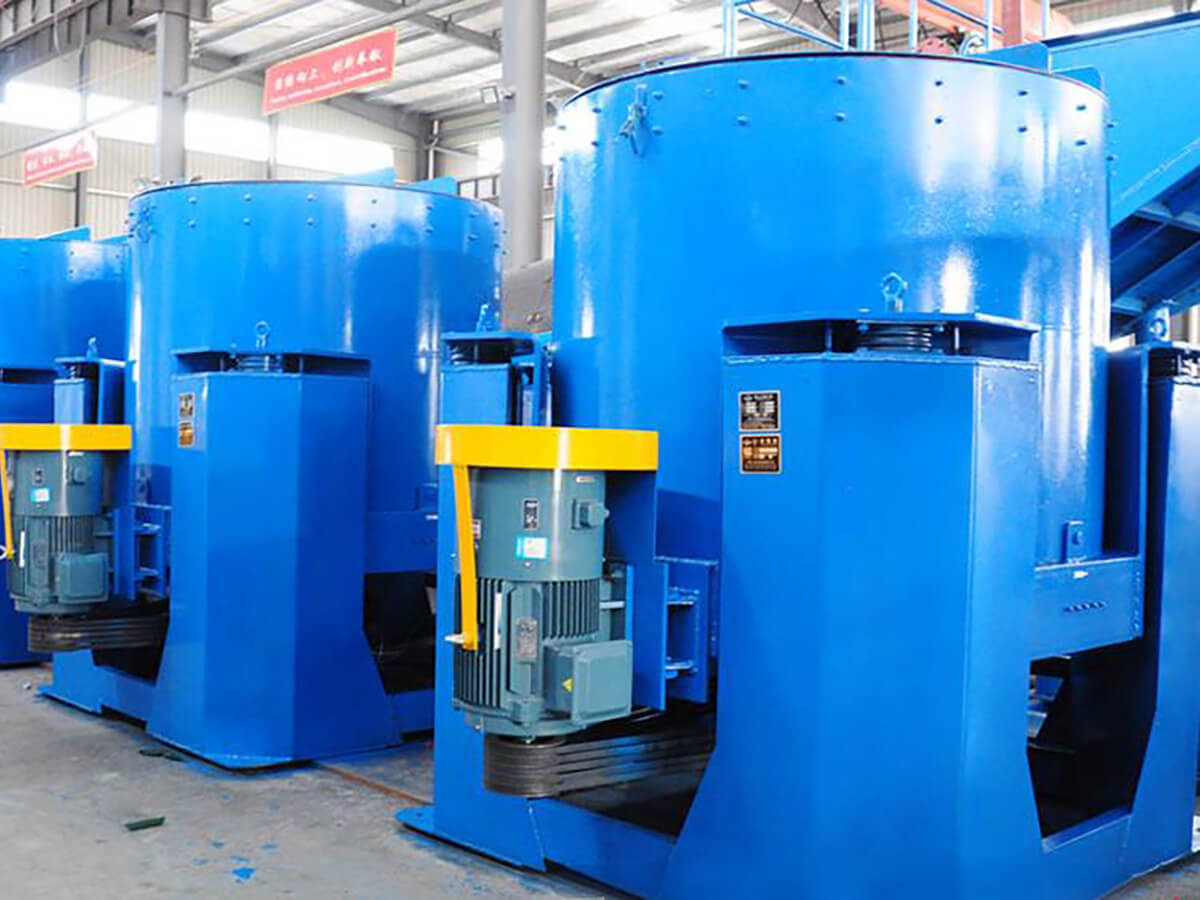
- Principle: Separation is carried out by utilizing the density difference between manganese minerals (specific gravity 4.5-5.0) and gangue (such as quartz, specific gravity 2.65);
- Commonly used equipment:
- Jigging machine: processes particles from 30mm to 3mm, suitable for coarse particle enrichment;
- Shaking table: processes particles from -3mm to finer particles, yielding high-grade concentrate;
- Typical process: The ore is crushed to 6-0mm and then grouped, with coarse particles being jigged and fine particles being separated by shaking table.
2. High-intensity magnetic separation: a mainstream mineral processing technology with strong adaptability.
- Manganese minerals are weakly magnetic (specific magnetic susceptibility 10×10⁻⁶~600×10⁻⁶ cm³/g), and can be effectively recovered under strong magnetic fields of 800~1600kA/m;
- This process can increase manganese grade by 4%~10%, is simple to operate, and highly adaptable, making it the dominant manganese ore beneficiation technology in China.
- New types of medium, coarse, and fine-particle strong magnetic separators are being applied successively, while micro-fine-particle strong magnetic separators are still in the experimental stage.
3. Flotation method: used for complex and difficult-to-process ores.
- For fine-grained, complexly intergrown manganese carbonate or high-iron, high-phosphorus ores;
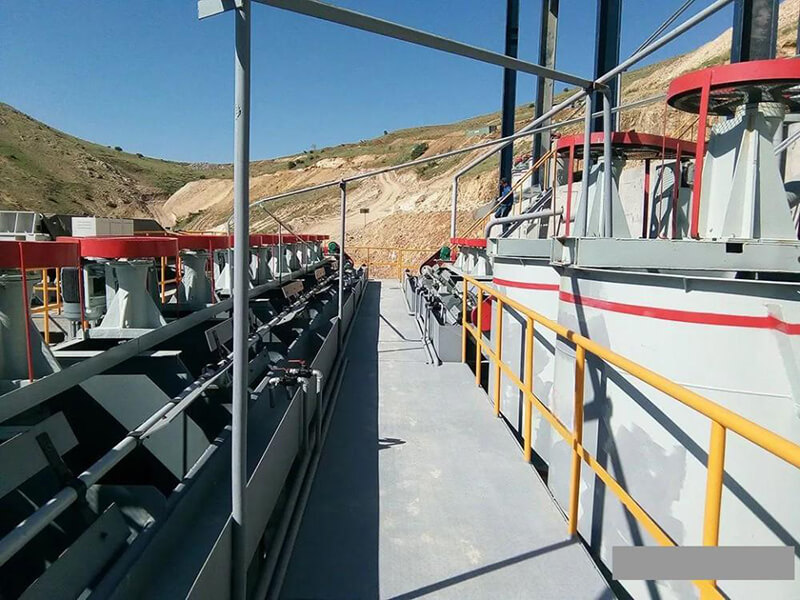
- Collectors are used to alter the surface properties of manganese minerals, causing attached air bubbles to float to the surface.
- This process is often combined with magnetic separation to form a "strong magnetic-flotation" process, as seen in the Zunyi manganese mine.
4. Integrated mineral processing flow: improving overall recovery rate
- In actual production, multiple methods are often combined, for example:
- Gravity-Magnetic Separation: The Liancheng manganese mine in Fujian uses jigging combined with high-intensity magnetic separation, achieving a concentrate grade of over 40%.
- High-Intensity Magnetic-Flotation: Processes low-manganese, low-phosphorus, and high-iron manganese carbonate ore.
- Washing-Gravity-Magnetic Separation: Comprehensive removal of mud, coarse particle enrichment, and fine particle purification.
VI. Sintering and Agglomeration: Improving Furnace Performance
For manganese ore intended for blast furnace smelting, sintering is often required to improve its strength and permeability.
- The process is completed on a belt sintering machine, where the mixture is ignited and sintered at high temperature to form porous, blocky sintered ore.
- During sintering, a low-melting-point liquid phase (such as manganese olivine) is generated as a binder phase;
- The ignition temperature is generally 1050–1250℃, and the time is extended to 90 seconds to mitigate the cracking caused by carbonate decomposition.
VII. Dehydration and Drying: Preparation of Final Product
The separated manganese concentrate has a high water content and needs to be dehydrated for storage and transportation.
- Concentration: Initial sedimentation using a thickener to increase the slurry concentration;
- Filtration: Further dewatering using a vacuum filter or filter press.
- Drying: If necessary, hot air drying in a rotary kiln to reduce the moisture content to below 10%.
VIII. Chemical Processing and Smelting: Preparation of High Value-Added Products
1. Chemical processing
- Acid method: Applicable to rhodochrosite (MnCO₃), where sulfuric acid is used to dissolve the ore to produce a manganese sulfate solution, followed by refining and crystallization.
- Alkaline method: Used for pyrolusite (MnO₂), where potassium manganate, potassium permanganate, and other chemical products are produced through oxidative roasting.
2. Smelting
- Blast furnace method: Produces high-carbon ferromanganese (containing 60%–80% manganese and 6%–7% carbon), using manganese ore, coke, and lime as raw materials for smelting;
- Electric furnace method: Used to produce medium- and low-carbon ferromanganese or electrolytic manganese;
- Electrolytic method: Produces electrolytic metallic manganese with a purity of over 99.7%, widely used in alloys, electronic materials, and other fields.