
Graphite Ore Mining Technology
Date: 2026-02-27 Categories: New Energy Minerals Views: 184
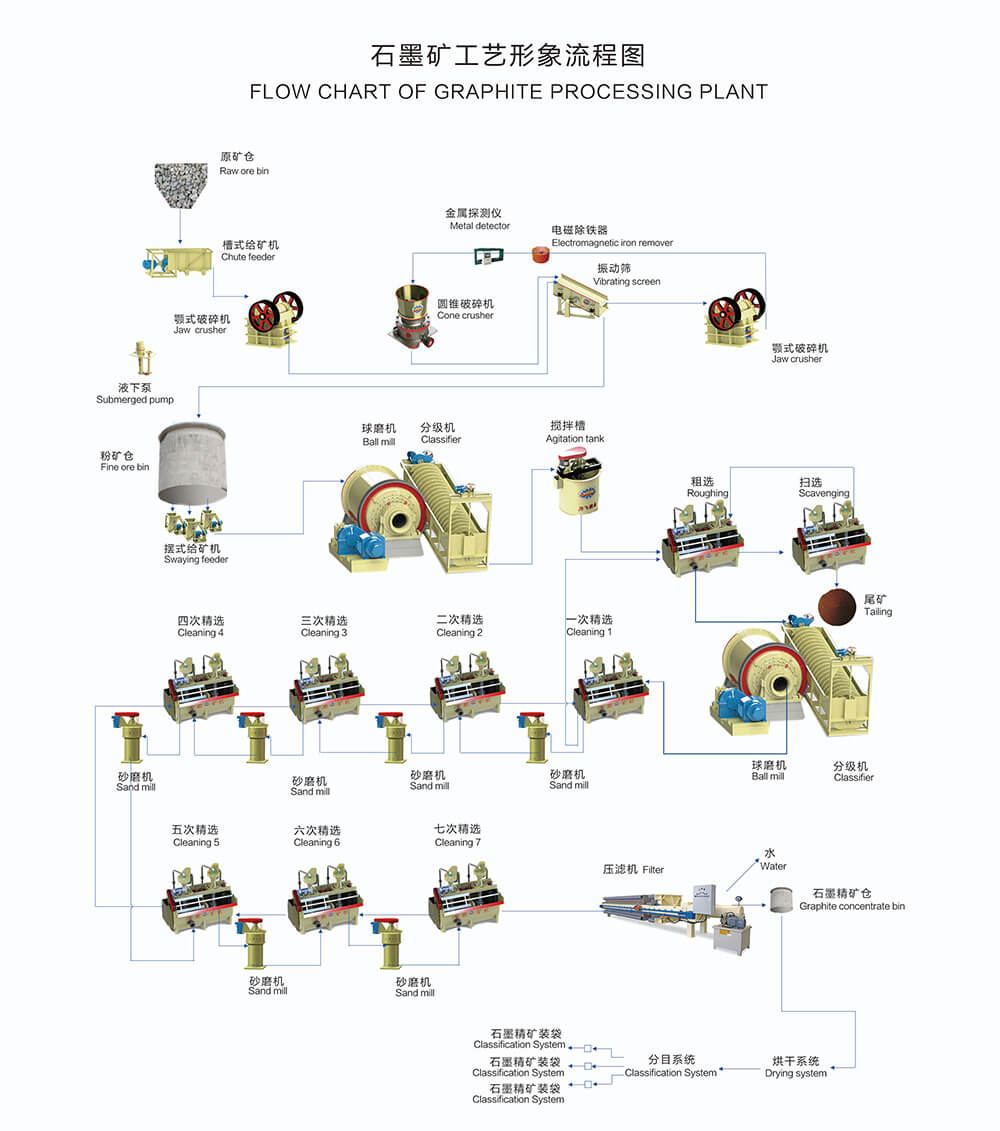
Graphite ore beneficiation technology is centered on flotation, combined with gravity separation, electrostatic separation, chemical purification, and selective flocculation. The process combination is selected based on ore properties and product requirements, as detailed below:
I. Core Beneficiation Methods
Flotation
Principle: Utilizing the differences in the physicochemical properties of the surfaces of graphite and gangue minerals, separation is achieved by adding flotation reagents (such as collectors and frothers).
Applicability: Suitable for fine-grained, disseminated graphite ores, and is the most commonly used method in graphite ore beneficiation.
Process Characteristics
Protection of Large Flakes: Employing multi-stage grinding, multiple separation processes, and regrinding and re-separation of the rough concentrate to prevent flake breakage.
Reagent Selection: Commonly used collectors include kerosene, diesel oil, and heavy oil; commonly used frothers include No. 2 oil, No. 4 oil, and butyl ether oil.
Process Optimization: By adjusting the grinding fineness, flotation cycles, and reagent formulation, concentrate grade and recovery rate can be improved.
Results: Graphite concentrate with a fixed carbon content of 80%–97%, reaching up to approximately 95%.
Gravity Separation
Principle: Separates graphite ore from gangue based on the difference in specific gravity.
Applicability: Suitable for graphite ores with significant specific gravity differences, such as those containing heavy minerals (e.g., pyrite, pyrrhotite).
Process Characteristics
Simple Equipment: Commonly uses jigs, shaking tables, and spiral sluices.
Easy Operation: Low cost, but relatively low separation accuracy.
Results: Obtains a rough concentrate primarily composed of graphite; further purification is required to maintain the fixed carbon content.
Electrostatic Separation
Principle: Separates minerals based on differences in conductivity.
Applicability: Suitable for graphite ores with significant conductivity differences, such as separating graphite from gangue minerals like feldspar, quartz, and pyrite.
Process Characteristics
Wide Particle Size Range: Can process graphite ores of various particle sizes.
Operation: Suitable for graphite ores with significant conductivity differences, such as separating graphite from gangue minerals like feldspar, quartz, and pyrite. High sorting efficiency: High-purity graphite concentrate can be obtained.
Effect: Effectively improves graphite purity, but the equipment cost is relatively high.
Chemical Purification Method
Principle: Removes impurities from graphite using chemical methods to improve purity.
Common Methods
Alkali-Acid Method: First, high-temperature alkali fusion removes acidic impurities such as silicates, followed by acid leaching to remove metal oxide impurities.
Acid Leaching Method: Reacts directly with impurities with acids (such as sulfuric acid, hydrochloric acid, hydrofluoric acid, etc.) to form soluble salts, which are then removed.
Chlorination Roasting Method: A reducing agent is added at high temperature, causing impurities to react with chlorine to form low-melting-point chlorides, which are then removed.
High-Temperature Roasting Method: Utilizes the difference in melting points between graphite and impurities, causing impurities to vaporize and separate at high temperatures.
Applicability: Suitable for applications requiring extremely high graphite purity, such as the production of high-purity graphite and nuclear energy graphite.
Process Characteristics
High Purification Effect: Can obtain high-purity graphite with a fixed carbon content of over 99.9%.
High Energy Consumption and Cost: Requires sophisticated equipment and may cause environmental pollution.
Effectiveness: Significant purification effect, but economic and environmental considerations must be taken into account. Selective Flocculation
Principle: A polymeric flocculant is added to a suspension containing multiple components, allowing the flocculant to selectively adsorb certain components, thus achieving component separation.
Applicability: Suitable for extensive and small- to medium-sized beneficiation plants, or as an auxiliary method to other mineral processing techniques.
Process Characteristics
Simple equipment and low cost: However, the fixed carbon recovery rate is relatively low (approximately 40%).
Easy operation: Suitable for rapid separation.
Effects: Can be used as a preliminary purification method; further purification requires a combination with other methods.
II. Basis for Process Flow Selection
Ore Properties: Based on the crystal morphology, grain size, and types and contents of associated minerals in the graphite ore, a suitable beneficiation method is selected.
Product Requirements: The beneficiation process flow and purification method are determined based on the intended use and purity requirements of the final product.
Economic Efficiency: Taking into account equipment investment, operating costs, energy consumption, and environmental requirements, an economically reasonable beneficiation process is selected.
Environmental Conservation: Environmentally friendly beneficiation processes are prioritized to reduce wastewater, waste gas, and solid waste emissions.