
Ilmenite (Titanium Ore) Mining Technology
Date: 2026-02-22 Categories: Non-Ferrous Metals Views: 200
The beneficiation processes for ilmenite (titanium ore) mainly include gravity separation, magnetic separation, flotation, and electrostatic separation, as well as the combined application of these methods. The following is a detailed introduction:
I. Gravity Separation Process
Principle: Separation is achieved by utilizing the density difference between ilmenite and gangue. Ilmenite has a higher density (approximately 4.7 g/cm³), while gangue minerals have a lower density (generally 2.6-2.8 g/cm³).
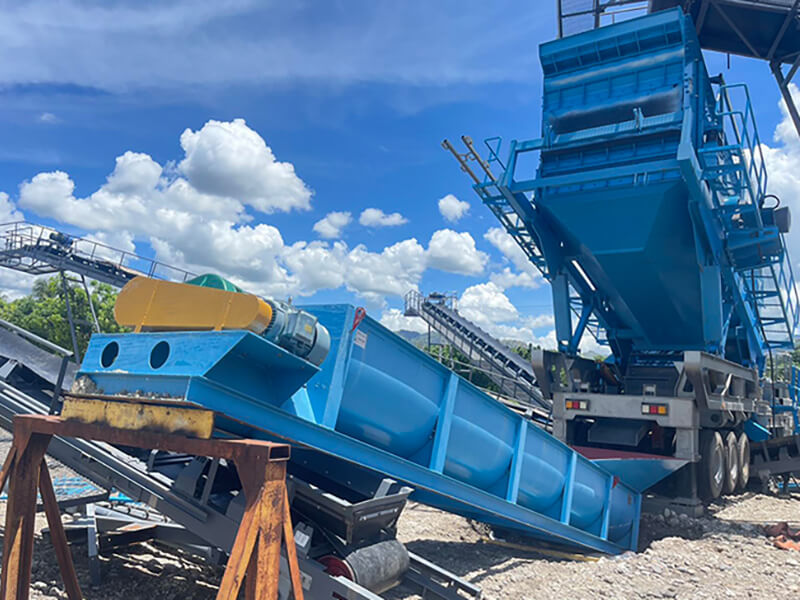
Equipment: Spiral sluices, shaking tables, etc.
Process
Crushing: The raw ore is crushed to a suitable particle size, generally controlled at 1-3 cm.
Grinding: The crushed ore is ground to a certain fineness to initially liberate the ilmenite and gangue. Typically, it is ground to a particle size of -200 mesh, with 40%-50% of the particles being gangue.
Gravity Separation: The ground slurry is fed into a spiral sluice or shaking table for separation. In a spiral sluice, the slurry flows in from the top and spirals downwards along the trough. Ilmenite, due to its higher density, moves along the inner side of the trough bottom, while gangue minerals move along the outer side, eventually exiting from different outlets. In a shaking table, through the combined action of table vibration and water flow, ilmenite gradually accumulates towards the front end of the table (concentrate end), while gangue is carried by the water flow to the rear end of the table (tailings end) for discharge.
Features: Gravity separation is simple, low-cost, and has minimal environmental pollution, making it suitable for processing ilmenite ore with coarse particle size and significant density differences.
II. Magnetic Separation Process
Principle: Separation is achieved using the weak magnetic properties of ilmenite. Ilmenite is adsorbed under a strong magnetic field, while gangue minerals are unaffected.
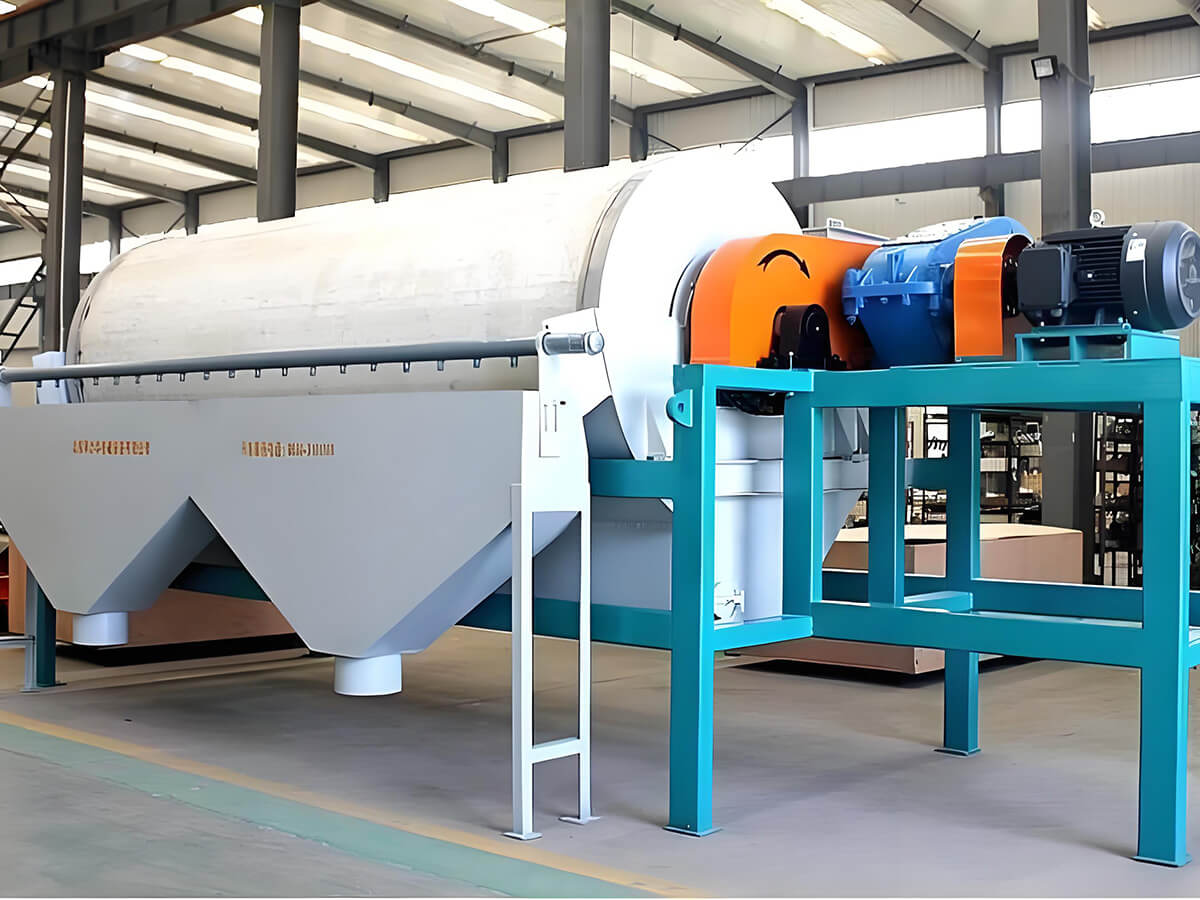
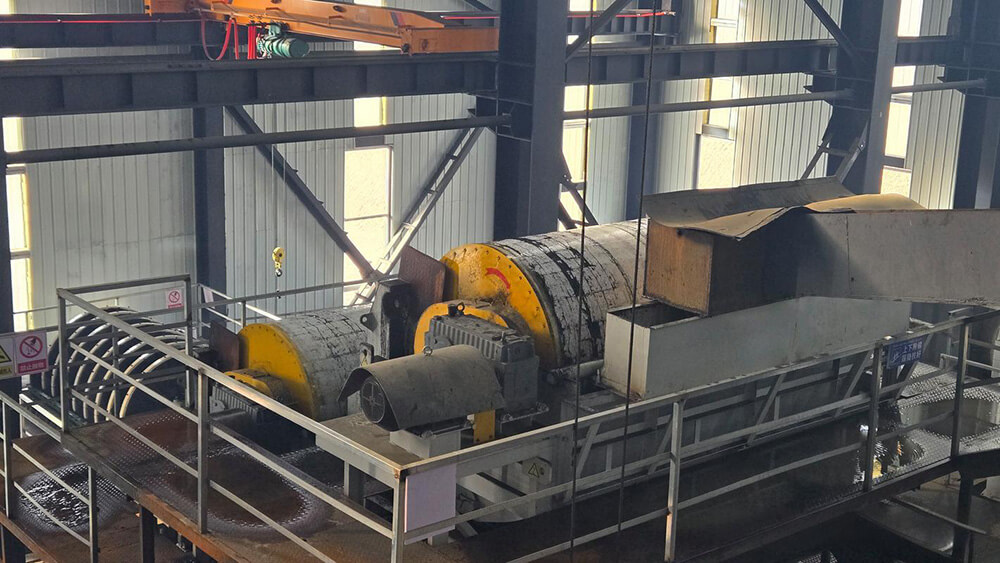
Equipment: High-intensity magnetic separator, such as a permanent magnet drum separator.
Process
Crushing and Grinding: Similar to gravity separation, the raw ore is crushed to a suitable particle size and ground to a certain fineness.
Desliming: The slurry after grinding undergoes desliming treatment to remove slime smaller than -325 mesh, preventing it from affecting the magnetic separation effect.
Magnetic Separation: The deslimed slurry is fed into a high-intensity magnetic separator for separation. As the slurry flows through the separation zone, ilmenite particles are attracted to the surface of the magnetic drum by the magnetic field. With the rotation of the drum, they are carried to the non-magnetic area and then washed down by the flushing water to become coarse concentrate. Non-magnetic gangue particles are not affected by the magnetic field and are discharged directly from the tailings outlet.
Features: Magnetic separation is suitable for processing fine-grained ilmenite or ores with poor gravity separation performance.
III. Flotation Process
Principle: Separation is achieved by utilizing the differences in the physicochemical properties of the surfaces of ilmenite and gangue minerals. By adding chemical reagents (such as collectors and frothers), the surface of ilmenite becomes hydrophobic, allowing it to easily adhere to air bubbles. This allows it to rise with the bubbles to the surface of the pulp, becoming the froth product (concentrate), while the gangue remains in the pulp as tailings.
Equipment: Flotation machine.
Process
Crushing and Grinding: The raw ore is crushed to a suitable particle size and ground to a certain fineness, typically to -200 mesh (80%-90%).
Adjusting Pulp pH: An adjuster (such as sodium carbonate) is added to adjust the pulp pH to 8-9.
Adding Collectors: Collectors (such as oxidized paraffin soap or talcum oil) are added to make the ilmenite surface hydrophobic.
Flotation: The ore pulp is fed into a flotation machine for flotation. The rotation of the impeller generates bubbles, and ilmenite particles adhere to these bubbles, forming a froth layer that becomes the rough concentrate. Gangue particles remain in the pulp as tailings.
Concentration: The rough concentrate is fed into a concentration flotation machine for further purification, increasing the concentrate grade.
Characteristics: Flotation is suitable for processing fine-grained ilmenite or ores closely associated with gangue, but the operation is relatively complex and requires various chemical reagents.
IV. Electrostatic Separation
Principle: Separation is achieved by utilizing the differences in electrical properties (such as conductivity and dielectric constant) between ilmenite and gangue minerals.
Equipment: Electrostatic separator, such as a drum separator.
Process
Gravity or Magnetic Separation: A rough concentrate is first obtained through gravity or magnetic separation.
Electrostatic Separation: The rough concentrate is fed into an electrostatic separator for further separation. An electrostatic separator typically has a rotating cylinder with electrodes inside. When mineral particles pass through the surface of a cylindrical separator, due to differences in electrical properties, some particles adhere to the surface while others are repelled, thus achieving separation.
Characteristics: Electrostatic separation is suitable for processing dry mineral particles and has strict requirements on particle size. It is typically used as a purification step in the concentrate process to further improve the grade of ilmenite concentrate.
V. Combined Process
Principle: Due to the complex properties of ilmenite ore, single beneficiation methods often fail to achieve ideal beneficiation results. Therefore, combined processes are often employed, integrating gravity separation, magnetic separation, flotation, and electrostatic separation for comprehensive separation.
Process
Gravity Separation-Magnetic Separation-Flotation: First, gravity separation removes most of the gangue and clay, yielding an enriched concentrate. Then, magnetic separation is applied to the gravity concentrate to further enrich ilmenite. Finally, flotation is performed on the magnetically separated concentrate to improve the concentrate grade.
Gravity-Magnetic-Electro-Electro-Separation: First, gravity and magnetic separation are used to obtain a rough concentrate; then, electro-separation is performed on the rough concentrate to further improve its grade. Electro-separation is particularly useful when the rough concentrate contains non-conductive minerals such as quartz in addition to ilmenite and rutile; it can be used as the final step in titanium concentrate production.
Features: This combined process can fully utilize the advantages of various beneficiation methods, improving the efficiency and grade of ilmenite beneficiation.