
Saudi Arabia Iron Ore Beneficiation Project
Date: 2026-02-28 Categories: Client Cases Views: 153
Saudi Arabia's iron ore beneficiation projects are accelerating, leveraging the country's abundant mineral resources and the "Vision 2030" industrial transformation strategy. Several large-scale projects have entered the construction or planning stages, covering the entire industrial chain from iron ore mining and beneficiation to green steel manufacturing. The projects generally employ a combined magnetic separation-flotation process to process low-grade ore, focusing on high-value-added products and low-carbon technologies.
This project involves processing low-grade magnetite with high silicon, low sulfur, low phosphorus, and high iron silicate and iron carbonate content. The ore structure is mainly banded, and the texture is primarily granular metamorphic rock. Saudi Arabia's low-grade magnetite is characterized by fine and unevenly distributed magnetite particles. The average particle size of iron minerals is 44.95 μm, and the average particle size of gangue minerals is 71.20 μm.
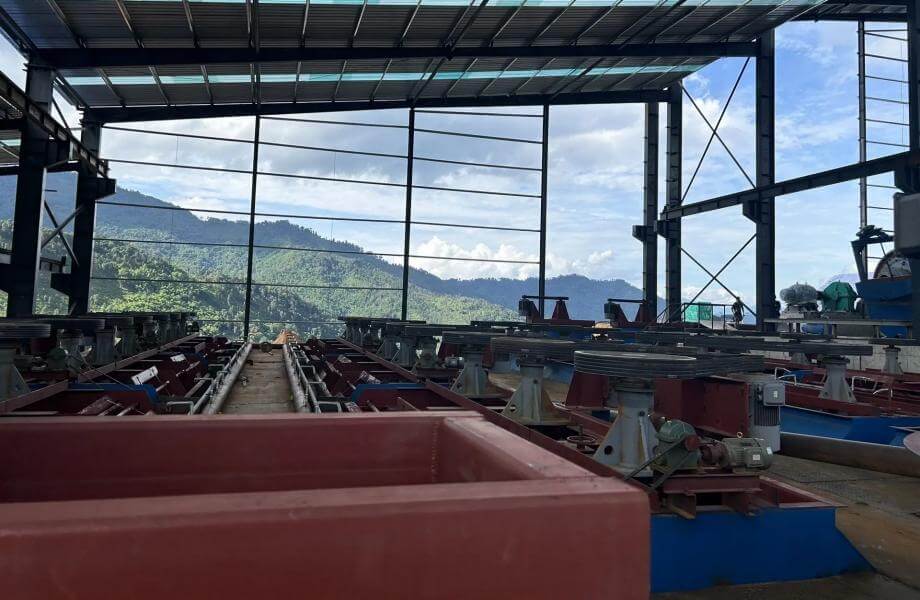
Based on the ore characteristics, a beneficiation process of staged grinding and single-stage magnetic separation is proposed. Staged grinding and magnetic separation can remove some low-grade tailings early on, thereby reducing the processing volume of subsequent grinding and magnetic separation processes. When the ore is ground to a particle size distribution of -0.074 mm reaching 55% to 65%, tailings with a grade below 10% and a recovery rate above 40% can be removed.
The raw ore mainly contains magnetic minerals, small amounts of ferrosilicon and ferric carbonate, and very little hematite and limonite. Therefore, a single-stage magnetic separation process is adopted. The full magnetic separation process has advantages such as a simple process, low operating cost, high iron recovery rate, and reliable technology. The staged grinding and single-stage magnetic separation process has achieved satisfactory results in the processing of Saudi Arabian iron ore.
For complex ores containing silicate and carbonate impurities, a combined magnetic separation-reverse flotation process is commonly used:
- Roughening stage: Medium-intensity magnetic separation (MIMS) recovers magnetic iron minerals and removes most of the quartz and fine slime.
- Finishing stage: Reverse cation flotation uses starch to suppress iron minerals and ether-amine collectors to selectively collect quartz.
- Results: A concentrate with an Fe grade of 63.91% and a SiO₂ content of 5.99% can be obtained, meeting the requirements for pellet production.